IGSHPA Accredited Installer. ClimateMaster GeoElite Dealer. 47 years HVAC experience. Dave Hartzell, Kingfisher, Oklahoma, 405-375-4822.
Last updated: April 2026
I’ve been installing geothermal heat pumps in central Oklahoma since the early 2000s. I’ve done horizontal loops on wheat-ground farms, vertical bores in tight Edmond lots, and pond loops on Canadian River properties. This guide covers everything I wish more homeowners knew before they called me: how the system actually works, what Oklahoma soil does to the numbers, real costs, every active rebate, and what the ROI looks like on a real central Oklahoma property.
How a Geothermal Heat Pump Works
A geothermal heat pump doesn’t create heat by burning fuel. It moves heat that already exists in the ground. In winter, fluid circulates through a loop buried in the earth, absorbs the ground’s stable 58-62°F temperature, and carries that heat into your home. In summer, the process reverses: heat from your home is transferred into the cooler ground. The refrigeration cycle inside the unit amplifies this exchange, producing 3 to 5 units of heating or cooling energy for every 1 unit of electricity consumed. That ratio is called COP (Coefficient of Performance) or EER for cooling.
For context: a high-efficiency gas furnace is 96% efficient, it converts 96 cents of every dollar of gas into heat. A geothermal heat pump operating at COP 4.0 delivers 400% efficiency. Oklahoma’s ground temperature holds that number up year-round.
Key components:
Ground loopHDPE pipe buried in trenches, bores, or ponds; lasts 50+ years
Heat pump unitrefrigerant cycle inside the conditioned space; lasts 20-25 years
Desuperheateroptional add-on that preheats domestic water at near-zero cost
Air handler or hydronic distributiondelivers conditioned air or radiant heat
Oklahoma Ground Temperatures by Region
The ground temperature at loop depth (8-20 ft for horizontal; 150-400 ft for vertical) is the single biggest factor in system performance. Oklahoma sits in a favorable band, warm enough that loops don’t exhaust in deep winter like they can in Minnesota, but not so warm that summer rejection becomes a problem.
Region
Mean Ground Temp (8-20 ft)
Soil Type
Loop Notes
Kingfisher / Northwest OKC
59-61°F
Clay / sandy loam
Good horizontal; some rock at 200+ ft
Enid / Garfield County
58-60°F
Red clay / loam
Horizontal viable; no major bedrock issues
OKC Metro (Logan / Canadian)
60-63°F
Clay, some shale
Vertical preferred on small lots
Major County / Western OK
57-60°F
Sandy / mixed
Horizontal on large acreage; good thermal conductivity
Blaine / Custer Counties
59-62°F
Red bed clay / sandstone
CKenergy territory, best rebates in state
Loop Types: Which One Works on Your Property
Horizontal Loops (Most Common in Rural Oklahoma)
Trenches dug 6-8 feet deep, typically 400-600 ft of pipe per ton of capacity. Requires about 1,500-2,000 sq ft of yard per ton. On a 3-ton system that’s roughly a half-acre of accessible, unobstructed ground. Cost is lower than vertical, trenching equipment is cheaper than drill rigs. Most Kingfisher County, Blaine County, and Major County properties qualify. I’ve run horizontal loops in wheat stubble fields, pastures, and large residential yards all over central Oklahoma.
Vertical Loops (Suburban and City Lots)
Bores drilled 150-400 ft deep, with U-bend pipe inserted and grouted. One bore per ton, typically 4-6 bores on a residential system. Drill rigs are expensive, adds $1,500-3,000 per bore versus trenching. Required when horizontal isn’t an option: Edmond and Yukon lots, in-town Guthrie, historic district properties. Performance is excellent, deep ground temps are rock-stable year-round.
Pond / Lake Loops
If you have a half-acre or larger pond at least 8 ft deep, coiled loop mats sink to the bottom. Most cost-effective installation method when the pond qualifies, no trenching or drilling. I’ve done pond loops on Canadian River-area properties in Canadian County. The pond must not freeze solid and must be large enough to handle thermal load without temperature creep.
Standing Column Wells
Less common in Oklahoma, requires the right aquifer conditions. Water is drawn from a well, run through the heat exchanger, and returned to the same well. Not widely applicable in central Oklahoma’s geology, though there are pockets in Garfield County where it’s viable.
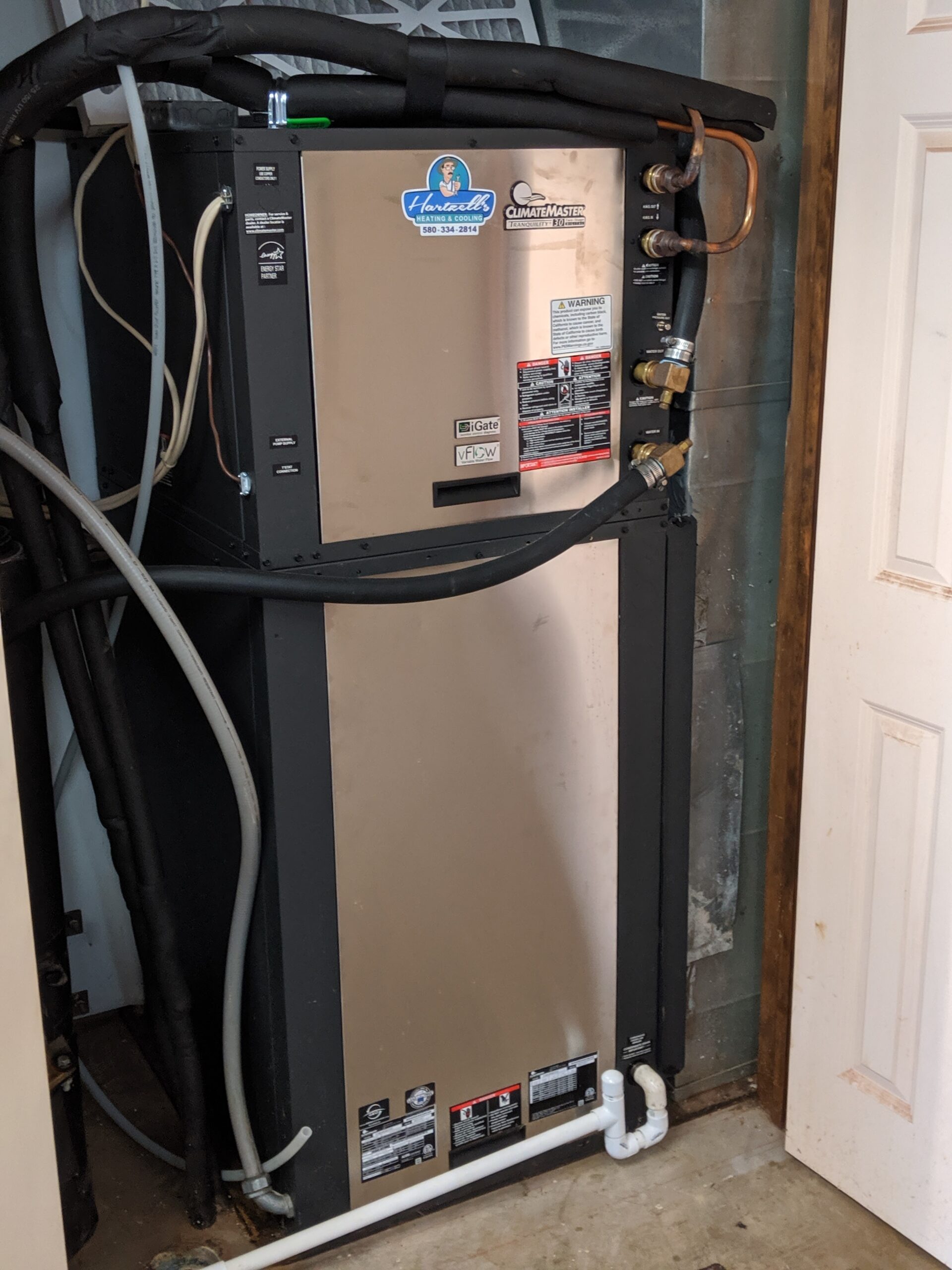
A geothermal heat pump install. These run on the steady temperature underground, not the Oklahoma air.A geothermal heat pump install. These run on the steady temperature underground, not the Oklahoma air.
>Geothermal Cost in Oklahoma: Real Numbers
Geothermal is a higher upfront investment than conventional HVAC. Here’s what I see on actual central Oklahoma installations in 2026:
System Size
Loop Type
Installed Cost (before rebates)
After CKenergy Rebate
After OG&E Rebate
2-ton (small home)
Horizontal
$15,000-$18,000
$11,000-$14,000
$13,000-$16,000
3-ton (avg. home)
Horizontal
$18,000-$22,000
$12,000-$16,000
$15,000-$19,000
3-ton (avg. home)
Vertical
$22,000-$27,000
$16,000-$21,000
$19,000-$24,000
4-ton (larger home)
Horizontal
$22,000-$28,000
$14,000-$20,000
$18,000-$24,000
5-ton (large home)
Horizontal
$26,000-$32,000
$16,000-$22,000
$21,000-$27,000
Note: Section 25D federal tax credit expired Dec 31, 2025. Oklahoma utility rebates remain fully active. Costs vary by soil conditions, loop field access, and existing ductwork condition.
Oklahoma Geothermal Rebates by County (2026)
This is the single most important table for Oklahoma homeowners. Which utility serves your address determines whether you get $4,000 back or nothing. I confirm utility territory before every proposal. Full details: Oklahoma geothermal rebates 2026.
Eastern/SE Oklahoma (Tulsa area), NOT in my service territory
Varies
Kingfisher County note: Kingfisher County is NOT in CKenergy territory. Depending on your exact address, you may be served by KPWA (city), Cimarron Electric (rural), or OG&E. Call me at 405-375-4822 and I can confirm your utility before you budget anything.
The loop field outlasts the heat pump unit, typically 50+ years versus 20-25 for the indoor unit. On the second unit replacement, you’re only replacing the mechanical equipment, not re-digging the loop. That second cycle is where geothermal becomes dramatically cheaper than conventional on a lifecycle basis.
Geothermal vs. Conventional Heat Pump
Geothermal pulls heat from 55 degree ground loops year round, so it runs 400 to 600 percent efficient. A conventional air heat pump fights 105 degree summer air and 10 degree winter air, dropping to 200 to 300 percent.
Factor
Geothermal
High-Efficiency Air-Source Heat Pump
Installed cost
$15,000-$30,000
$6,000-$12,000
Efficiency (COP)
3.5-5.0
2.0-3.5 (drops at extreme cold)
Performance at 5°F outside
Full rated efficiency (ground is 59°F)
Reduced, needs aux. heat strip
Outdoor unit noise
None, no outdoor unit
Compressor/fan noise outdoors
Equipment lifespan
20-25 yr unit / 50+ yr loop
12-18 years
Annual maintenance
Lower, no outdoor coil to clean
Higher, outdoor coil/refrigerant checks
Water heating integration
Yes, desuperheater at near-zero cost
No
Oklahoma rebate programs
Up to $2,000/ton (CKenergy)
Up to $1,500/unit (OG&E HVAC rebate)
Lot size requirement
1/2+ acre preferred for horizontal
None, outdoor unit only
The Installation Process: What to Expect
A typical geothermal install runs 3 to 5 days: day 1 loop drilling (4 to 6 bores, 200 to 300 feet each), day 2 trenching and header, day 3 indoor unit and ductwork tie-in, days 4 to 5 commissioning and flush.
Site assessmentI walk the property, confirm utility territory, check soil conditions, measure lot dimensions, review existing ductwork. Free for new system estimates.
Manual J load calculationI size the system to the actual heat loss/gain of your specific home. Oversizing a geothermal system is expensive and wastes rebate dollars.
Loop designhorizontal layout or bore count determined by load calc and lot constraints. IGSHPA-standard design software, not guesswork.
Utility rebate pre-applicationI handle the paperwork. Some utilities (CKenergy) require pre-approval before equipment is ordered.
Loop field installationtrenching or drilling subcontractor I’ve worked with for years. HDPE pipe fusion-welded, pressure-tested before burial.
Indoor unit installationClimateMaster or WaterFurnace unit set, refrigerant charged, controls wired. Desuperheater plumbed if included.
Commissioning and testingloop pressure, water temperature delta, refrigerant charge, airflow across all zones. I don’t leave until the numbers are right.
Rebate submissionI submit the required documentation to your utility. You receive the check directly, typically 4-8 weeks post-installation.
Brands I Install
I install ClimateMaster (GeoElite dealer), WaterFurnace, and Bosch geothermal units, plus Trane and Amana for conventional pairings.
ClimateMaster I’m a GeoElite Dealer, their highest dealer tier. Manufactured in Norman, Oklahoma. Tranquility and Trilogy series cover residential applications from 1.5 to 6 tons. Some of the highest EER ratings in the industry.
WaterFurnace Strong residential and commercial lineup. The 7 Series is their most efficient unit, variable-speed compressor with COP up to 5.3. Good fit for larger homes with hydronic distribution.
Bosch Good value in the 2-3 ton residential market. SM series is straightforward to install and service. I use Bosch on budget-sensitive projects where ClimateMaster’s premium tier isn’t necessary.
Frequently Asked Questions
How much does geothermal cost in Oklahoma?
Installed cost before rebates runs $15,000-$30,000 depending on system size, loop type, and soil conditions. After CKenergy’s $2,000/ton (Source: CKenergy) rebate (available in Blaine, Canadian, Custer, and 7 other counties), a 3-ton horizontal system can come down to $12,000-$16,000. OG&E territory gets $1,000/ton. The federal 30% Section 25D tax credit expired December 31, 2025 and is no longer available for 2026 installs. Call 405-375-4822 for a free estimate specific to your property.
Is the federal geothermal tax credit still available in 2026?
No. Section 25D, which covered 30% of geothermal installation costs, expired December 31, 2025. It is no longer available for systems installed in 2026. Oklahoma utility rebates from CKenergy, OG&E, Cimarron Electric, OEC, KPWA, and CVEC remain fully active. These are the rebates to focus on in 2026.
How much land do I need for a geothermal system in Oklahoma?
For a horizontal loop (the most common type in rural central Oklahoma), plan on 1,500-2,000 sq ft of accessible ground per ton of capacity. A 3-ton system needs roughly a half-acre of unobstructed yard or field. Vertical loops require no yard space beyond the drill rig access, just a few bore locations, but cost more per bore. Pond loops are an option if you have a qualifying body of water. I assess every property before proposing a loop type.
What is the payback period for geothermal in Oklahoma?
In CKenergy territory with horizontal loops, I typically see 9-13 years to simple payback. OG&E territory with vertical loops runs 15-24 years. Those numbers assume current electric rates, as rates rise, payback shortens. The loop field lasts 50+ years, so after the first equipment cycle you’re only replacing the indoor unit, not re-digging. On a 40-year horizon, geothermal almost always wins on total cost.
Does geothermal work well in Oklahoma winters?
Better than air-source heat pumps do. Air-source heat pump efficiency drops when it gets below 20-30°F outside because the outdoor coil has less heat to pull from cold air. Geothermal doesn’t care about outdoor temperature, the ground at loop depth holds 58-62°F year-round in central Oklahoma. A geothermal unit during a January ice storm runs at the same efficiency as it does in October. No auxiliary heat strip running. No defrost cycle.
Can I add a desuperheater for water heating?
Yes, and it’s one of the best value-adds in geothermal. A desuperheater captures waste heat from the refrigeration cycle and transfers it to a storage water heater. During the cooling season, it can provide near-free hot water, heat that would otherwise be rejected to the ground loop. Annual water heating costs typically drop 40-70%. I include desuperheater hookup in most residential installs. You still need a backup water heater element for peak demand or heating-season periods when the geo unit isn’t running as much.
What is IGSHPA accreditation and why does it matter for Oklahoma rebates?
IGSHPA is the International Ground Source Heat Pump Association, the industry’s certification body for geothermal design and installation. IGSHPA Accredited Installer means I’ve completed their formal training and passed testing on ground loop design, soil thermal analysis, and system commissioning. Several Oklahoma utility rebate programs (including CKenergy) require that the installer hold IGSHPA accreditation. If your contractor isn’t IGSHPA accredited, you may not qualify for the rebate even if the system is installed correctly.
How is geothermal maintained compared to a regular HVAC system?
The ground loop requires essentially no maintenance, HDPE pipe with no moving parts, buried and forgotten. The indoor unit needs the same annual maintenance as any heat pump: filter changes, coil check, refrigerant verification, blower motor inspection, condensate line clear. Because there’s no outdoor coil exposed to weather, grass clippings, hail, and Oklahoma red dirt, geothermal units tend to stay cleaner and have fewer refrigerant issues over time. I offer geothermal-specific maintenance plans starting at $360/yr. See Geothermal Maintenance Plans.
Ready to Talk Geothermal?
Free property assessment. I confirm your utility territory, walk the lot, and give you real numbers before you commit to anything. IGSHPA Accredited. ClimateMaster GeoElite Dealer.