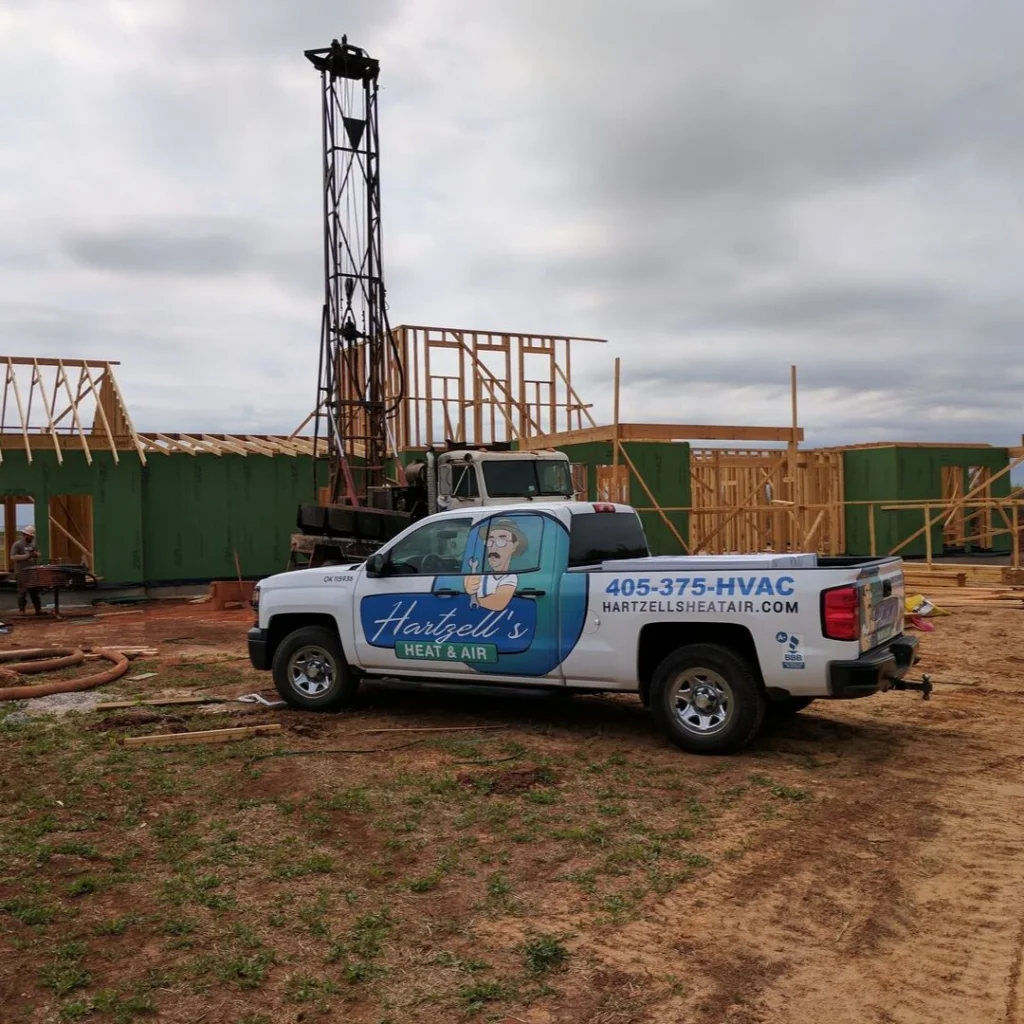
Oklahoma’s Geothermal Hub: IGSHPA Accredited, Have Experience, Will Travel
Geothermal is not complicated if you know what you are doing. I have been installing ground source heat pump systems for 15 years across central Oklahoma. I am IGSHPA Accredited, a ClimateMaster GeoElite Dealer, and I handle the CKenergy, OG&E, and OEC rebate paperwork so my customers get every dollar they are owed. I serve all of central Oklahoma. Have experience, will travel.
IGSHPA Accredited Installer | ClimateMaster GeoElite Dealer | Master HVAC License | 4.8 Stars / 276 Reviews
Manufacturer-Trained by ClimateMaster | Financing: Synchrony / Wells Fargo / Wisetack
See also: Geothermal Installation | Geothermal Heat Pump Installation Oklahoma | Geothermal Repair | Geothermal Maintenance | Rebates 2026
Oklahoma Geothermal Rebates I Handle
The rebates below are active for 2026 installations. I have completed these applications many times and I handle the paperwork for my customers. You should not have to figure out the forms yourself.
| Utility | Rebate | Max | Service Area |
|---|---|---|---|
| CKenergy | $2,000 / ton | $24,000 | Blaine, Caddo, Canadian, Comanche, Custer, Dewey, Grady, Kiowa, Roger Mills, Washita counties |
| OG&E | $1,000 / ton | Varies | Garfield County (Enid), Oklahoma County |
| OEC | $400-$700 / ton | Varies | Logan County area |
| Cimarron Electric | $600 flat | $600 | Kingfisher area cooperative |
| KPWA | Confirmed program | Call | Kingfisher city utility |
| CVEC | Confirmed program | Varies | Canadian Valley territory (mycvec.coop) |
| HEEHRA (federal) | Up to $8,000 | $8,000 | Not yet launched in Oklahoma. I will apply when it goes live. |
Note: Federal Section 25D tax credit expired December 31, 2025. Oklahoma utility rebates are fully active for 2026 installs.

Loop Types: What I Install in Oklahoma
The loop field is the heart of a geothermal system. Pick the wrong loop for your property and the system will never hit the efficiency it was sold on. Oklahoma soils, water tables, and lot sizes are not the same as Minnesota or Florida, so I size loops for the ground I have actually drilled into across Kingfisher, Blaine, Canadian, Garfield, and Logan counties.
Vertical Closed-Loop
A drilling rig sinks boreholes 150 to 300 feet deep. Two pipes per borehole carry antifreeze solution down and back up. Vertical loops are my recommendation when the lot is small, the homeowner does not want the yard torn up, or the soil layer above hard rock is shallow. Footprint is tiny: a 4-ton system needs about four boreholes spaced 15 feet apart. Cost runs higher than horizontal because of the drilling rig, but performance is consistent year-round because deep soil holds a steady 60 to 65 degrees in Central Oklahoma.
Horizontal Closed-Loop
Pipe is buried in trenches 5 to 6 feet deep. The trench length runs 400 to 600 feet per ton of capacity. Horizontal loops are my first pick when the homeowner has acreage and does not mind a few days of trenching. The install cost is the lowest of any loop type because a trencher is far cheaper to run than a drilling rig. The trade-off is shallower soil temperature swings, so loop length has to be sized correctly. I have installed horizontal loops on acreage in Blaine County, Major County, and northern Canadian County.
Pond or Lake Loop
If the property already has a pond at least 8 feet deep and a half acre in surface area, a pond loop is the cheapest install I can offer. Coiled pipe sits at the bottom of the pond, weighted down with concrete pads. Water is a much better heat transfer medium than soil, so loop length drops and efficiency goes up. I will not dig a pond just to use one, but if you already have one on the property, ask me about it.
Open-Loop (Pump and Dump)
Open-loop systems pull water from a well, run it through the heat pump, and discharge it back into a second well or a pond. In Oklahoma I only recommend open-loop when there is a strong, clean, high-volume aquifer under the property and a legal discharge point. Water quality matters: high iron or hard water will scale up a heat exchanger fast. I test the water before I quote an open-loop system. Most Oklahoma homes are a better fit for closed-loop.
Ton Sizing for Oklahoma Homes
A geothermal system in Oklahoma typically needs 1 ton of capacity per 500 to 600 square feet of well-insulated home. A 2,400 sq ft house lands at 4 to 5 tons. A 3,000 sq ft house lands at 5 to 6 tons. Those numbers are starting points, not the answer.
I do not size systems by rule of thumb. I run a Manual J load calculation before I quote any geothermal install. Manual J accounts for window orientation, attic insulation, duct losses, wall R-value, and infiltration rates. A 2,400 sq ft house in Kingfisher with R-30 attic and tight windows might only need 3.5 tons. The same square footage in a 1970s ranch with single-pane windows can easily need 5 tons. Oversizing a geothermal system is expensive both upfront (loop field is bigger than it needs to be) and on operating cost (system short-cycles and never reaches steady-state efficiency). Undersizing means the home will not stay comfortable on the hottest July days. Manual J is the only way to get it right.
You can run your own Manual J first with my free load calculator, then we compare notes during the free in-home estimate.
Efficiency Numbers: Why Geothermal Wins
Geothermal heat pumps run at a Coefficient of Performance (COP) of 4.0 to 5.0. An air-source heat pump runs at COP 3.0 to 3.5. Translation: for every 1 unit of electricity you put in, geothermal returns 4 to 5 units of heat. Air-source returns 3 to 3.5. On the cooling side, geothermal hits EER 25 to 30. Conventional central air sits at EER 13 to 18.
The top of the line ClimateMaster Trilogy 45 Q-Mode series I install hits COP 5.0+ and Energy Star certified EER of 41 in some configurations. That is the highest rated geothermal heat pump on the market. In real-world Oklahoma operating conditions, I see customers cut heating bills 50 to 70 percent compared to propane or electric resistance, and cooling bills 30 to 50 percent compared to an old SEER 10 air conditioner. Those numbers come from utility bill comparisons my customers send me, not marketing brochures.
Cost Breakdown: Real Numbers for an Oklahoma Install
A typical 4-ton geothermal install in Oklahoma runs $25,000 to $40,000 before rebates. The range reflects loop type (horizontal cheapest, vertical most expensive, pond loop cheapest of all if a pond exists), home access, ductwork condition, and equipment tier. ClimateMaster Trilogy at the top, ClimateMaster Tranquility 30 in the middle, ClimateMaster Tranquility 22 at the entry level. All three carry the same loop, so the loop investment travels with you even if you upgrade the indoor unit 15 years later.
After rebates the math gets interesting. A 4-ton install on a CKenergy meter returns $8,000 in utility rebate, dropping the net to $17,000 to $32,000. Add OG&E rebate stacking where applicable, plus financing through Synchrony, Wells Fargo, or Wisetack, and the monthly cost often lands at or below what the homeowner was already paying in propane and electric. Payback runs 7 to 12 years on $200 to $400 per month in utility savings, depending on the size of the home and what the system replaces. The loop lives 50+ years and the indoor unit lives 20 to 25 years.
Loop Install Process: What Three to Five Days Looks Like
A conventional air conditioner swap takes me a day. A geothermal install takes 3 to 5 days, sometimes a week for larger systems or wet weather delays. Here is the actual sequence:
Day 1, drilling or trenching. For vertical loops, the drilling rig arrives on a trailer and sets up. Each borehole takes 2 to 4 hours depending on rock layers. For horizontal loops, a trencher cuts the 5 to 6 foot trenches across the property. The trencher leaves less mess than most homeowners expect because the soil mounds along the trench and goes right back in.
Day 2, pipe insertion and header trench. The vertical pipe loops are dropped into the boreholes with a U-bend at the bottom. The boreholes are grouted with thermally conductive bentonite from the bottom up. Once boreholes are sealed, I dig a header trench from the boreholes back to the house and run the supply and return mains.
Day 3, manifold and antifreeze. All the individual loops tie into a manifold near the foundation. The system is filled with a propylene glycol antifreeze solution rated for Oklahoma winter lows. The whole loop field is pressure tested at 100 PSI for a minimum of 30 minutes to confirm zero leaks. I will not bury a system that does not hold pressure.
Day 4-5, indoor unit, ductwork, commissioning. The ClimateMaster indoor unit is set, ductwork is connected or modified, refrigerant lines are brazed, and the system is electrically wired. I commission the system with my IGSHPA loop pressure tools and verify entering water temperature, leaving water temperature, and Delta-T across the heat exchanger. The system gets a final efficiency report that goes into your file in case CKenergy or OG&E ask for it during the rebate process.
After commissioning, I walk the homeowner through the ClimateMaster 360 thermostat, the loop pressure gauge in the mechanical room, and what to call me about (rare) versus what is normal (a quiet system running long, steady cycles).
Geothermal Maintenance Plans
Geothermal systems are designed for 20+ years of service, but they do need annual attention. I offer three tiers of geothermal maintenance:
Geo Basic, $360/yr. Annual tune-up, system inspection, loop pressure check, refrigerant pressures, and electrical safety check.
Geo Plus, $428/yr. Everything in Basic, plus priority scheduling, no-overtime pricing, and a 15 percent parts discount on any repair that comes up.
Geo 360, $499/yr. Everything in Plus, plus loop repressurization included if the loop needs a top-off, full diagnostic credit, and same-day priority dispatch. This is the plan I recommend for any geothermal system more than 5 years old. Loop pressure drift is the single most common reason a 10-year-old geo system underperforms, and Geo 360 makes that a non-issue.
Learn more on the geothermal maintenance plans page.
Where I Work
I install and service geothermal systems across all of central Oklahoma. Kingfisher County is my home base, but geothermal installs are large projects and worth the drive. I have completed installations in Blaine County, Canadian County, Garfield County (Enid), Major County (Fairview), Logan County, and beyond. If your utility has a rebate program, I make the trip.

Why IGSHPA Accreditation and ClimateMaster GeoElite Matter
IGSHPA Accreditation is the ground source heat pump industry’s professional certification. It covers loop sizing, system design, and installation standards. The coursework and field evaluation are specific to geothermal, not general HVAC. Most HVAC shops hold a state mechanical license and nothing else. IGSHPA Accreditation means I have been tested on the actual science of how ground loops work and how to size them correctly for Oklahoma soils.
ClimateMaster GeoElite is the top dealer tier with ClimateMaster, the leading American geothermal manufacturer. It means direct factory support, priority parts access, and access to the best equipment warranties available. In 2016, Air Products Supply, ClimateMaster’s regional distributor, named Hartzell’s “Best Newcomer of the Year” across their entire dealer network.
Rebate paperwork: I have completed the CKenergy, OG&E, OEC, and Cimarron Electric rebate applications many times. I handle the paperwork so my customers never leave money on the table. A CKenergy rebate on a 5-ton system returns $10,000. That is not money you want stuck in a bureaucratic form.
Manufacturer Training and System Design. I am not just a ClimateMaster dealer. I am factory-trained, which means I have been through ClimateMaster's technical curriculum on system design, loop field sizing, and installation standards. I also do the full system design in-house, including Manual J load calculations and loop field layout, before a single hole is drilled. Most HVAC shops outsource that or skip it. I do not.
Geothermal Questions
How far do you travel for geothermal installs in Oklahoma?
Anywhere in central Oklahoma. A geothermal system is a significant investment and deserves the right installer. I have driven to Watonga, Fairview, Enid, and beyond. The rebate money usually covers the difference. Call 405-375-4822 and tell me where you are.
How much is the CKenergy geothermal rebate in Oklahoma?
$2,000 per ton of system capacity, up to $24,000. A 3-ton system returns $6,000. A 5-ton system returns $10,000. CKenergy covers 10 counties including Blaine, Canadian, Custer, and Grady. I handle the application for you.
Do you install geothermal systems in Enid Oklahoma?
Yes. I serve Garfield County including Enid. OG&E offers a $1,000 per ton rebate for geothermal in that territory. Call me for a free site assessment and I will tell you exactly what the system will cost after the OG&E rebate.
What is the difference between IGSHPA Accreditation and a regular HVAC license?
A Master HVAC license covers the mechanical and refrigeration side of heating and cooling equipment. IGSHPA Accreditation is specific to ground source heat pump systems, covering loop field design, soil thermal conductivity, system sizing, and installation standards. Not all Master HVAC technicians have it. In Oklahoma, very few do.
How much does geothermal cost in Oklahoma?
A typical 4-ton geothermal install runs $25,000 to $40,000 before rebates. After a CKenergy rebate of $8,000, the net drops to $17,000 to $32,000. The actual quote depends on loop type, home size, and equipment tier. I do free estimates, call 405-375-4822.
What rebates are available for geothermal in Oklahoma?
CKenergy pays $2,000 per ton up to $24,000 across 10 counties. OG&E pays $1,000 per ton. OEC pays $400 to $700 per ton. Cimarron Electric pays $600 flat. KPWA and CVEC have confirmed programs. HEEHRA federal up to $8,000 is pending Oklahoma rollout. The federal Section 25D tax credit expired December 31, 2025.
How long does geothermal installation take?
Three to five days for a typical residential install. Day 1 is drilling or trenching, day 2 is pipe and headers, day 3 is manifold and antifreeze pressure test, days 4 to 5 are the indoor unit, ductwork, and commissioning. Bad weather or larger systems can stretch it to a week.
Will geothermal work on my Oklahoma property?
Almost certainly. Vertical loops fit small lots. Horizontal loops fit acreage. Pond loops fit properties with an existing pond at least 8 feet deep. Open-loop fits the rare case of a strong, clean aquifer. I do a site walk during the free estimate and tell you which loop is right for your soil and lot.
How long do geothermal systems last?
The loop field is rated for 50-plus years. The indoor heat pump unit runs 20 to 25 years with regular maintenance. When the indoor unit eventually wears out, the loop stays in the ground and the next unit ties right into it. The biggest investment you make is the loop, and you only make it once.
Is the Section 25D federal tax credit still available for geothermal in 2026?
No. Section 25D expired December 31, 2025. It is no longer available for new installations. The good news is that Oklahoma utility rebates, including CKenergy at up to $24,000, are still fully active for 2026 installs. That is the money to focus on.
What Our Customers Are Saying
4.8 stars • 276 verified Google reviews
Free in-home geothermal estimate.
I install ClimateMaster GeoElite and handle every OG&E and CKenergy rebate, up to $24,000 off your system.
Frequently Asked Questions
Geothermal or air-source heat pump: which one wins in Central Oklahoma?
Geothermal wins on long-term operating cost (40 to 60 percent lower bills), 25-year equipment life, and total comfort. An air-source heat pump wins on upfront cost (one third the price) and a faster 3 to 6 year payback. If you are staying in the house 12-plus years AND your CKenergy or OG&E utility pays the rebate, geothermal. If either is no, modern variable-speed heat pump.
What is the real cost difference between geothermal and a heat pump in Oklahoma?
A 3-ton geothermal install in Kingfisher County runs $24,000 to $45,000 depending on loop type. A comparable 3-ton variable-speed air-source heat pump runs $9,000 to $16,000. The price gap shrinks 30 to 50 percent for CKenergy and OG&E customers once 2026 utility rebates land.
How much does each system actually cost to run each month in Oklahoma?
A 3-ton geothermal in a typical 2,000 sq ft Kingfisher home pulls $480 to $720 a year in heating-and-cooling electricity at 12 cents per kWh. An air-source heat pump in the same home pulls $1,100 to $1,500. That is roughly $40 to $80 a month in real savings, every month, for the next 25 years.
Do air-source heat pumps work in Oklahoma winters?
Modern variable-speed cold-climate heat pumps (Mitsubishi Hyper-Heat, Trane TruComfort) hold 100 percent capacity to 5 degrees and 75 percent to minus 13 degrees. They handle Oklahoma winters fine. The cooling-side gap in 105-degree July still favors geothermal by 25 to 35 percent because no air-source unit beats a 70-degree ground loop in the hottest week of the year.
What is the payback period on geothermal vs a heat pump in Central Oklahoma?
Geothermal payback in Central Oklahoma runs 8 to 14 years on a typical 3-ton home after utility rebates. Heat pump payback runs 3 to 6 years. If you plan to stay 12-plus years and your utility pays a rebate, geothermal wins long-run. Otherwise, the heat pump wins on time-value-of-money.
Financing available. Geothermal systems are a significant investment and the right time to do it is when the rebate window is open. I offer financing through Synchrony, Wells Fargo, and Wisetack. Many of my customers finance the out-of-pocket portion after the utility rebate and pay less per month than they were spending on gas and electric.
Free Interactive Tools
Get a real number before you call. These calculators use actual Oklahoma utility rates and rebate amounts.
Geothermal Rebate Calculator, Enter your county and system size, get the exact rebate amount.
Energy Savings Calculator, See how much geothermal saves vs. your current system annually.
Repair vs. Replace Calculator, Is it worth fixing your current system or time to replace?
New to geothermal? Read The Complete Guide to Geothermal Heat Pumps in Oklahoma, how they work, cost, rebates, and whether they make sense for your property.
Geothermal Service Areas, Towns I Cover
My home base is Kingfisher, but geothermal installs are large projects and I make the drive. Here are the towns I work in regularly:
Not on this list? Call 405-375-4822, I serve all of central Oklahoma for geothermal projects.
Ready to Talk Geothermal?
I offer free estimates on all geothermal installs. I will tell you what the system will cost, which rebates apply to your utility territory, and how long the payback period looks. No pressure.
Call 405-375-4822
Or get a free estimate at hartzellsheatair.com
CKenergy customer? If you live in CKenergy territory, see the CKenergy geothermal rebate page for current $2,000 per ton rebate details, eligible counties, and how to apply.