
Closed Loop vs Open Loop Geothermal
A closed loop is sealed pipe with the same fluid circulating through it
forever. An open loop pulls water out of a well, takes the heat out of it, and discharges it. Closed loop
is what I install on almost every Oklahoma home.
4.8 stars, 300+ Google reviews
Both work. Both are real geothermal. They fail in completely different ways, and that is the part worth
understanding before you sign anything.
Closed loop: the same fluid, forever
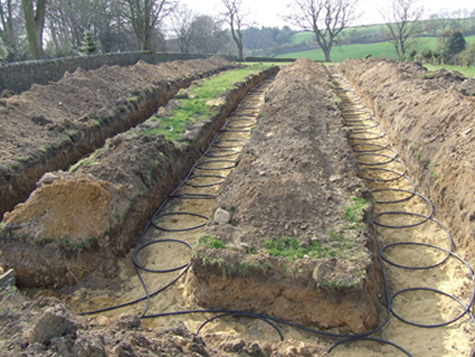
High density polyethylene pipe goes in the ground, gets fused into a sealed circuit, gets pressure
tested, and then the same fluid circulates through it for the life of the system. Nothing enters, nothing
leaves. It exchanges heat with the dirt through the pipe wall.
What I like about it: it does not care about your water table, your iron content, or your well’s mood
this year. Pressure test it, purge the air out, and it is a closed system with almost nothing to go wrong.
Loops routinely outlive the equipment attached to them by decades.
What it costs you: the ground work. Trenching or drilling is the expensive part of a geothermal job, and
a closed loop is all ground work.
Open loop: your well does the work
An open loop, sometimes called pump and dump, draws groundwater from a supply well, runs it through a
heat exchanger, and discharges it to a second well, a pond, or a legal surface discharge. You are not
buying a loop field. You are borrowing the water.
When it works, it works beautifully and it saves the cost of the loop field. But it puts three questions
on the table that a closed loop never asks:
- Yield. Your well has to deliver enough water every single minute the system runs, in
August, in a dry year, for twenty years. A well that keeps a house in drinking water is not automatically a
well that can feed a heat pump. - Water chemistry. Oklahoma groundwater varies a lot. Iron, hardness, and sediment will
foul a heat exchanger, and fouling shows up as an efficiency loss long before it shows up as a failure. - Discharge. The water has to go somewhere legal and permanent. That is a real
engineering and regulatory question, not a shrug, and it needs answering before anybody quotes you.
I do not rule open loop out. I rule it out for your property only after looking at the well and the
water, and if the answers do not hold up I say so instead of selling it anyway.
Side by side
| Closed loop | Open loop | |
|---|---|---|
| What circulates | Sealed fluid, same fluid forever | Groundwater, once through |
| Up front cost | Higher, you are buying the loop field | Lower when a suitable well already exists |
| Depends on | Ground and available space | Well yield, water chemistry, legal discharge |
| Main risk | A poorly designed or undersized field | Fouling, and a well that cannot keep up in a dry year |
| Maintenance | Very little, check loop pressure | Ongoing, heat exchanger cleaning and water treatment |
| Who I recommend it for | Almost every Oklahoma home | Properties with a proven high yield well and clean water |
What this choice does to your wallet
The dollar version
Open loop can look cheaper on install day, and sometimes genuinely is. The place people get hurt is
years three through ten, when a fouled heat exchanger quietly eats the efficiency they bought the system
for, or a dry summer turns the well into the problem.
Closed loop costs more up front and then mostly stops asking you for anything. Either way, a properly
running geothermal system cuts heating and cooling energy use by roughly half versus the conventional or
propane system it replaced.
If an existing geothermal system is already acting up, that is my Geothermal Diagnostic, $348 flat. Full
performance audit: loop pressure, refrigerant charge, desuperheater, controls, heat exchanger, with a
written report and quote before I leave. No credit, no refund, no money back. See
geothermal repair.
The part nobody can inspect later
Once a loop is backfilled it is invisible for the life of the house. There is no opening it up for a
second opinion. That is the entire reason I am IGSHPA accredited and why I do the loop work rather than
handing it to the low bidder. A loop is the one part of your system where being cheap is permanent.
The long version of this decision, including the property questions I ask before I will design an open loop.
Questions I get about this
Which is better, closed loop or open loop geothermal?
Closed loop for almost every Oklahoma home. Open loop only when the property has a proven, high yield well with clean water and a legal place to discharge it. I check all three before I recommend it, and if any one of them is shaky, I say closed loop.
Can I use my existing water well for geothermal?
Maybe. The question is not whether the well works, it is whether it can deliver water continuously while the system runs, in a dry August, for decades, and whether the water chemistry will leave the heat exchanger alone. That takes a look at the well, not a phone call.
Does a closed loop ever need refilling?
It should not. It is sealed. If loop pressure is dropping, you have a leak, and that is a real finding rather than routine topping off. Anyone who keeps adding fluid every year without finding the leak is treating a symptom.
Is open loop legal in Oklahoma?
Groundwater use and discharge are regulated, and the rules that apply depend on your well and how the water is being returned. I confirm what applies to your specific property before designing an open loop system rather than assuming.
How long does a geothermal loop last?
The buried pipe routinely outlives the equipment it is connected to by a wide margin. In practice you will replace the heat pump inside the house long before the loop under the yard is the problem.
Keep going:
Not sure which one your property can support?
Tell me about your land and your well and I will tell you straight. If open loop is right for you I will design it. If it is not, I will tell you that too, before you have spent anything. New system estimates are free, statewide.
Dave Hartzell, Hartzell's Heat & Air, 602 S Main St, Kingfisher, Oklahoma. Master HVAC License, NATE Certified, IGSHPA Accredited, ClimateMaster GeoElite. New system estimates are free anywhere in Oklahoma. Diagnosing an existing geothermal system is my $348 flat Geothermal Diagnostic, no credit and no refund, with a written report before I leave.