
Horizontal vs Vertical vs Pond Loop
4.8 stars, 300+ Google reviews
Horizontal loops go in trenches and need land. Vertical loops go in boreholes
and need almost none. Pond loops sink coils in water and cost the least when you already have the water.
In Oklahoma the deciding factor is usually how much clear yard you have.
4.8 stars, 300+ Google reviews
All three are closed loops. All three do the same job. What changes is how the pipe gets into the
ground, what that costs, and what your property can actually accommodate. Loop pipe per ton depends on the shape it takes: roughly 400 to 600 feet for a straight horizontal loop, 600 to 800 feet for a slinky trench, and about one 300-foot coil for a pond loop.
Horizontal: trenches, and the cheapest ground work if you have the room
Pipe goes into trenches a few feet down, spread out across the yard or the field, then gets backfilled.
It is the most common choice on rural Oklahoma property for one simple reason: out here, land is the thing
people have.
What it needs is clear, diggable, unobstructed ground. Not landscaping you love, not a septic field, not
where the new shop is going. A three ton system is about 1,200 feet of pipe that has to lie down somewhere.
What it does to your yard is real and worth saying plainly: it is an excavation. It heals, grass comes
back, but the week it happens your yard is a job site. I would rather you hear that from me now than be
surprised on day two.
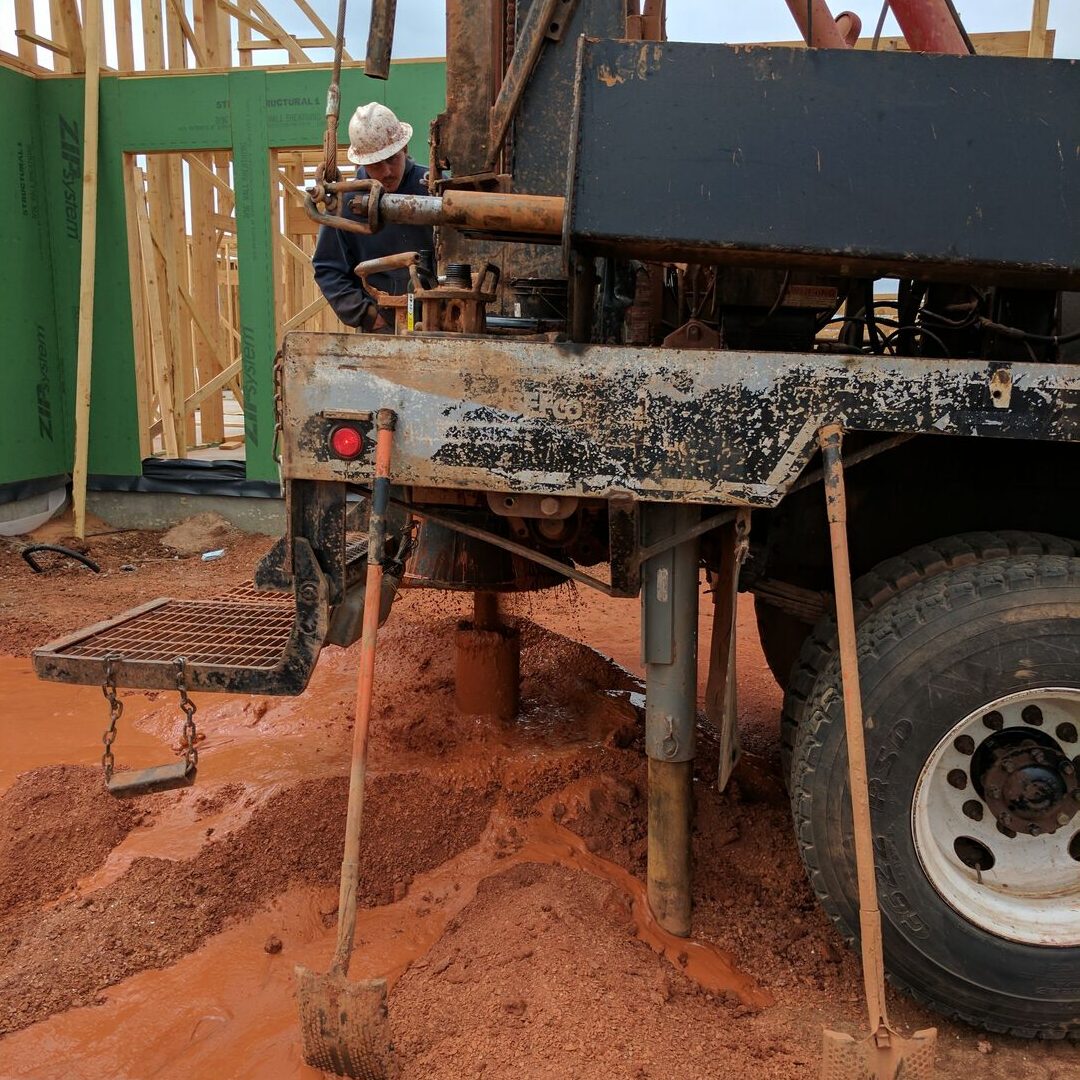
Once vertical is the answer, spacing and headers start driving the cost. Vertical borefield design in Oklahoma covers depth, spacing, headers, and flow.
Vertical: boreholes, for lots that do not have the room
Instead of spreading pipe sideways, you drill and stack it. A few bore locations, a U-bend of pipe down
each one, grouted back in. Vertical takes almost no yard space beyond rig access.
This is what makes geothermal possible on a tight Edmond or Yukon lot where a horizontal field would
never fit. It costs more per foot than trenching, because drilling costs more than digging, and Oklahoma
geology varies a lot in what it does to a drill bit. Red clay behaves one way. The gypsum country out
around Watonga and Okeene behaves another.
The grout matters here in a way most homeowners never hear about. A vertical bore is only as good as its
thermal contact with the rock around it, and that contact is the grout. Cheap grout is a permanent, buried
efficiency loss.
Pond and lake: the least expensive ground work, when the water qualifies
Coiled loop mats sink to the bottom of a pond deep enough not to freeze solid and large enough to absorb
the thermal load without swinging temperature. No trenching, no drilling. When a property has qualifying
water, this is usually the cheapest loop field on the table.
The catch is that the pond has to actually qualify. Depth, surface area, and whether it holds through a
dry Oklahoma summer are all part of it. A stock pond that half disappears in August is not a heat sink.
Side by side
| Horizontal | Vertical | Pond or lake | |
|---|---|---|---|
| Needs | Clear, diggable acreage | Rig access only | A qualifying body of water |
| Ground work cost | Lower | Highest | Lowest when the water qualifies |
| Yard disruption | Significant, it is an excavation | Limited to bore locations | Minimal on land |
| Typical Oklahoma fit | Farm and acreage property | Suburban and city lots | Canadian River area and pond properties |
| Watch out for | Septic, utilities, future building plans | Geology, and grout quality | Pond depth and whether it holds in a dry year |
Lot size is what usually forces the answer in town. I go through what that means in El Reno, Mustang, and Yukon, where vertical bores are usually the only loop that fits.
What the loop choice does to your wallet
The dollar version
The loop field is the biggest single swing in what a geothermal job costs, and it is set almost entirely
by your property rather than by which equipment you pick. Two identical houses with identical heat pumps can
be thousands apart on the loop alone.
That is exactly why I will not quote geothermal over the phone. I have to see the ground. What I can tell
you before I come out is that new system estimates are free, and for geothermal I travel across almost the entire state of Oklahoma, depending on the customer and the project, and that ENERGY STAR certified geothermal heat pumps
are on average over 45% more energy efficient than standard options.
Once the type is settled, the numbers start. Loop design: bore depth, flow, head, and antifreeze in Oklahoma is where the design actually gets sized.
How I actually decide
I walk the property. I look at how much clear ground there is and what is under it, where the septic and
the utilities run, what you are planning to build in the next ten years, and whether there is water worth
using. Then I size the load, size the loop against it, and pick the shape that fits. In that order. The loop
type is an output of the design, not a preference I bring with me.
Geothermal is the one thing I do statewide. My daily service trucks stay near Kingfisher, but for a
ground loop the whole drilling operation loads up and comes to your ground, anywhere in Oklahoma.
The long version on loop fields: what they are, what they cost, and the part of the bid most homeowners never think to compare.
Questions I get about this
Which geothermal loop is cheapest?
A pond loop when you have qualifying water, then horizontal when you have the land, then vertical. But cheapest on install day is not the goal. A short or badly designed field costs you efficiency for the life of the system, and you cannot go back and fix it.
How much land do I need for a horizontal geothermal loop?
Plan on roughly 400 feet of pipe per ton, laid out in trenches with spacing between them, on ground that is clear and diggable. That is why I walk the property instead of answering this from a map. If the room is not there, vertical bores solve it.
Can you drill a vertical loop in Oklahoma clay and gypsum?
Yes, and the geology is exactly why the drilling gets priced per property. Red clay drills differently than the gypsum country out west. That variation is a reason to have somebody who has drilled here do the work.
How deep does a geothermal bore go?
Deep enough to fit the loop the design calls for, spread across the number of bores that makes sense on your lot. It is set by the load and the geology, so it is a design output rather than a fixed number I can quote before seeing the site.
Will a loop install tear up my yard?
A horizontal field is an excavation, and I will not pretend otherwise. It heals and grass comes back. A vertical field is much less disruptive because it is limited to bore locations. If yard disruption is your main worry, say so up front and it becomes part of the design decision.
Keep going:
Let me look at your ground before anybody quotes you.
The loop field is the biggest variable in the whole job and it is decided by your property, not by a catalog. I will walk it, tell you which field fits, and give you a real number. Free estimate, across almost the entire state of Oklahoma.
Dave Hartzell, Hartzell's Heat & Air, 602 S Main St, Kingfisher, Oklahoma. Master HVAC License, NATE Certified, IGSHPA Accredited, ClimateMaster GeoElite. New system estimates are free, and for geothermal I travel across almost the entire state of Oklahoma, depending on the customer and the project. Diagnosing an existing geothermal system is my $348 flat Geothermal Diagnostic, no credit and no refund, with a written report before I leave.