
Does Geothermal Remove Humidity in an Oklahoma Summer?
4.8 stars, 300+ Google reviews
Yes, and the reason is runtime, not colder air. A properly sized two-stage or variable-speed geothermal unit runs long stretches at low capacity, so air keeps crossing a cold wet coil and water keeps draining out.
4.8 stars, 300+ Google reviews
The real question: does geothermal pull the moisture out, or does it just blow cold air like what I have now?
An Oklahoma summer is a moisture problem
Two kinds of heat are in your air, and your thermostat knows only one. Sensible heat is what a thermometer reads. Latent heat is heat stored in water vapor, invisible to a thermometer. You feel it anyway, because sweat will not evaporate into air already loaded with water. That is why 75 degrees at 53 percent is pleasant and 75 at 65 percent is a locker room.
The only way a cooling system removes latent heat is to condense that vapor back to liquid. Air has to touch a coil colder than its own dew point, and the drops that form have to run out the drain. No condensate, no dehumidification.
In July around Kingfisher the dew point sits in the low 70s for weeks. Every door, every gap, every shower adds more, and that load arrives whether the thermostat is satisfied or not.
Why an oversized system leaves the house cold and clammy
A system too big for the house, or one with a single on-off stage, slams on at full capacity and satisfies the thermostat in seven or eight minutes. Off it goes, feeling effective.
But the first minutes of any cycle are almost entirely sensible. The coil has to get cold, then colder than the dew point of the air crossing it, and only then does condensate form and find the drain. Moisture removal starts slow and improves the longer it runs.
Then it gets worse. The coil is still soaking wet when the compressor stops, and if the blower keeps turning, house air carries a good share of it back into the supply duct. Repeat that a dozen times and you get the July complaint: cold house, thermostat says 72, still feels damp. Dropping it to 70 shortens the cycles and makes it worse.
The mechanism is longer runtime at part load
Say it plainly, because most writing on this dances around it: longer runtime at lower capacity is the mechanism.
A two-stage unit spends most of the summer in first stage, roughly two thirds of full output, and a variable-speed unit holds a low output for hours. Deliberately weaker than the design-day number, it runs longer, so air spends far more time on a cold wet coil. On most staged equipment the blower slows at low stage too, which lets the coil run colder, so each pound of air gives up more water.
Geothermal plays that game better than an air conditioner can, because of the ground. An air-source unit loses capacity as outdoor air heats up, so its size gets padded for the worst afternoon of the year, and that padding is what short cycles the other ninety days. A ground loop rejects heat into earth holding in the low 60s year round, so it never needs the padding. Sized honestly, it runs longer. Running longer, it dehumidifies.
What the desuperheater does with that heat
Be precise here, because marketing copy muddles it: a desuperheater does not dehumidify anything. It is a small heat exchanger that intercepts the very hot refrigerant leaving the compressor and moves part of that heat into your water heater tank.
The connection to humidity is runtime. One cause, two payoffs. The long summer cycles wringing water out of your air are the same run hours feeding the tank, and that heat was headed into the ground anyway. That is why summer is when hot water assist pays. Full version on what a desuperheater is.
Sizing decides comfort, not the brand on the box
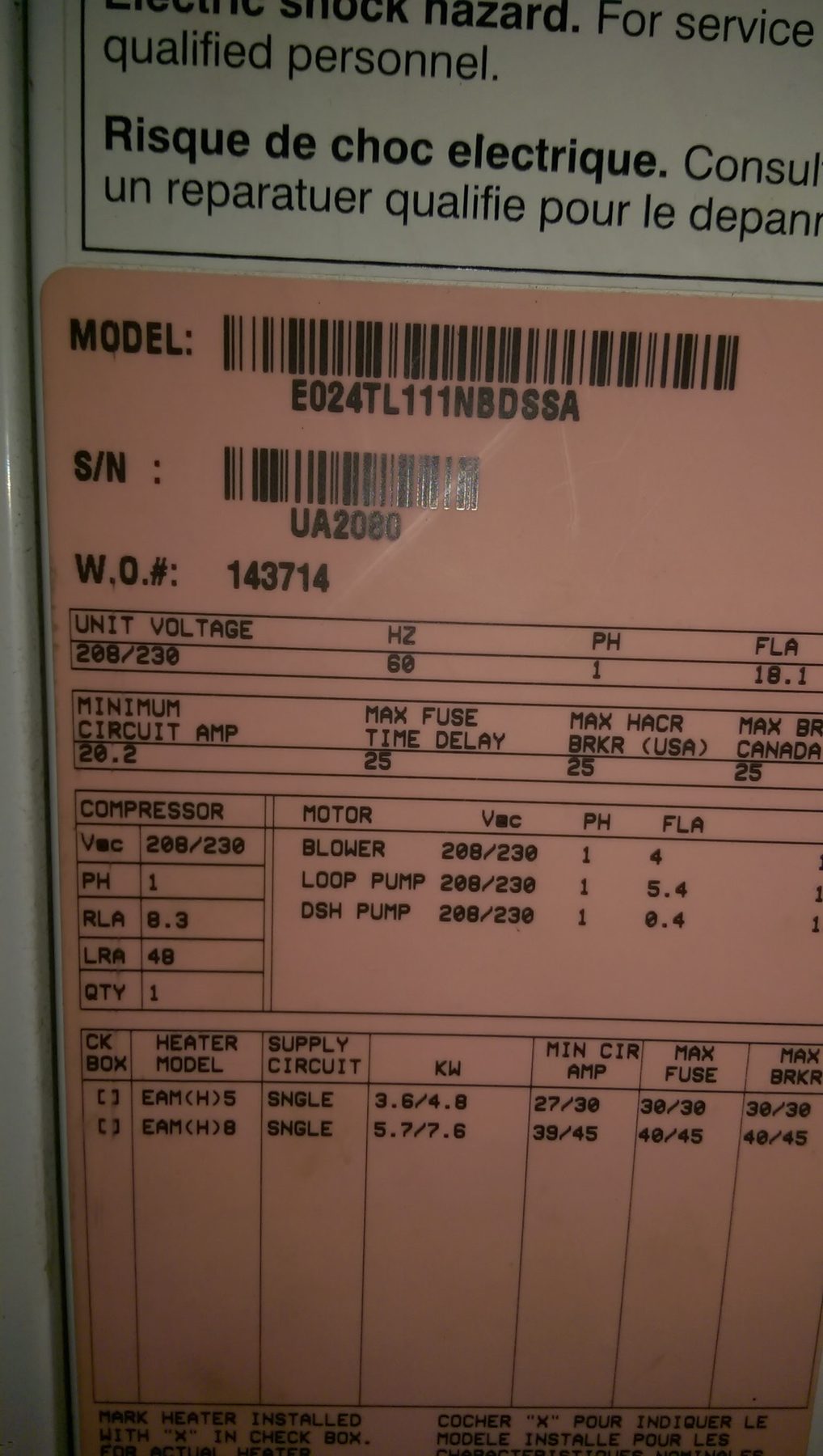
A real load calculation is a room by room Manual J: windows and which way they face, insulation, air leakage, duct location, how many people live there. It produces a sensible number and a latent number.
Two shortcuts cause most of the clammy houses in this state: a ton per so many square feet, which ignores everything that drives a load, and matching whatever is already sitting there, which is circular, because that unit may be the oversized box that created the complaint. What a ton actually means is worth two minutes.
On geothermal, oversizing costs twice. An extra ton is a bigger machine and more ground loop, and that money goes into the dirt permanently. Then it runs worse: short cycles, weak moisture removal, and a compressor taking its biggest gulp of power at every start. Comfort problem and efficiency problem, one decision. See how a geothermal heat pump works and is geothermal worth it in Oklahoma.
What good actually looks like
Relative humidity in the low to mid 50s, holding steady, without freezing anybody out to get there. Seventy-five at 53 percent is comfortable. Seventy-one at 63 percent is not, and it costs more.
Steady matters as much as the number: a house swinging from 48 to 62 across an afternoon is short cycling even if the average looks fine. Buy a hygrometer and watch it over a week, not an hour.
A good machine on bad duct will not dry a house
Airflow across the coil decides how cold the coil surface gets. Push too much air over it and the coil never gets far below the dew point, so the system drops temperature well and removes water poorly. Fixing that setting alone has cured clammy houses.
Returns are the other half. A leaky return in a hot attic or a vented crawlspace pulls humid unconditioned air straight into the equipment, so the machine fights a moisture load the duct built for it. I measure static pressure on installs and on diagnostics.
For what that looks like on a real house, a lake-area home I ran the load on near Lake Texoma came out at nearly 21,000 Btuh of latent cooling, which is exactly why I size off a Manual J instead of off floor area.
The honest limit: geothermal is not a dehumidifier
It removes moisture only as a byproduct of cooling, so no call for cooling means no drying. June through September that is plenty. May and late September are different: the dew point outside is still in the 60s and the house barely needs cooling, so there is not enough runtime. Humidity climbs indoors even on a perfectly sized system.
Same in a very tight new build, a walkout basement, or a house with a heavy moisture load. There the right answer is a dedicated whole-house dehumidifier ducted into the system, on its own humidistat. Saying that probably costs me a sale now and then, but you would rather hear it now than find out in your second May.
Questions I get about this
Does geothermal remove humidity better than a regular AC in Oklahoma?
Yes, when it is sized right and staged or variable-speed. The advantage is runtime: long stretches at low capacity are when a coil condenses the most water. A correctly sized conventional system still beats an oversized geothermal one, so sizing matters more than the label.
Why does my house feel cold and clammy at 72 degrees?
The system satisfies the thermostat before it has run long enough to wring water out of the air. Usually that is an oversized or single-stage unit, sometimes too much airflow across the coil.
What humidity level should my house be at in an Oklahoma summer?
Low to mid 50s, steady, at a thermostat setting you would actually pick. At 53 percent most people are comfortable at 75 degrees.
Does a bigger air conditioner dehumidify better?
No, worse. Bigger reaches the setpoint faster and shuts off sooner, and moisture removal is the slow part of a cooling cycle. Oversizing is the most common cause of a cold clammy house.
Do I still need a whole-house dehumidifier if I have geothermal?
Most Oklahoma homes do not during the real cooling season. One earns its place in the mild shoulder weeks of May and late September, and in tight new construction.
Keep going:
Cold and still damp? Let me size it honestly
Estimates on a new system are free, and for geothermal I travel across almost the entire state of Oklahoma, depending on the customer and the project. The load calculation comes with it, so you get the sensible and latent numbers for your actual house. If you already own geothermal and it will not pull the humidity down, that is my Geothermal Diagnostic, $348 flat at any hour, written report before I leave.
Dave Hartzell, Hartzell's Heat & Air, Kingfisher, Oklahoma. Master HVAC License, NATE Certified, IGSHPA Accredited, ClimateMaster GeoElite. 47 years in the trade, 15+ years in business. Geothermal is statewide Oklahoma. New system estimates are free.